
Has Poverty Really Ended in India? What the World Bank's 2.6% Actually Means
India's extreme poverty fell from 27.1% to 2.6% on the World Bank's $3-a-day line. One line up, at $4.20 a day, 16.1% of Indians are still below it. Which line someone quotes decides the story.
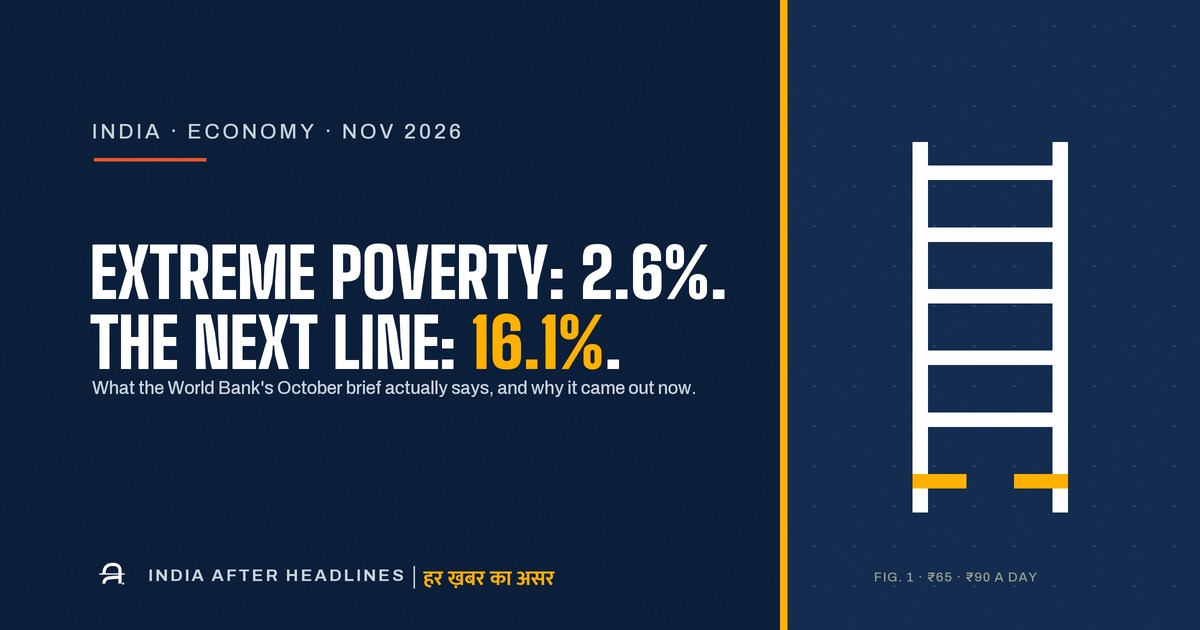
Short answer: No. The World Bank’s October 2026 Poverty & Equity Brief says India’s extreme poverty, below $3 a day (about ₹65 per person per day at purchasing-power rates), fell from 27.1% to 2.6% between 2011 and 2023. That is real, and one of the fastest falls in the world. But the same World Bank brief says 16.1% of Indians, roughly 23 crore people, still live below the next line of $4.20 a day (about ₹90). Real earnings in India were broadly flat over the period, and youth unemployment rose.
The misconception: “the World Bank says poverty is over”
The headline number is true. What it measures is narrow. The World Bank’s 2.6% counts people below one very low line, $3 a day. A family of four spending about ₹7,800 a month, all told, clears it.
“$3 a day” here is a purchasing-power dollar: dollars valued at what they buy in India, not at the bank exchange rate. That is why $3 becomes about ₹65 a day.
What the brief actually says
- Extreme poverty ($3 a day): 27.1% in 2011 to 2.6% in 2023.
- The next line ($4.20 a day, about ₹90): 16.1% of Indians, roughly 23 crore people, are still below it.
- Non-money poverty fell too. India’s multidimensional poverty index, which tracks things like electricity, cooking gas, drinking water and schooling, dropped from 53.8% in 2005-06 to 16.4% in 2019-21.
So both things are true at once: very few Indians are now in the deepest poverty, and a very large number are only a little above it.
The fine print
The World Bank itself says some of the gain may reflect better measurement. India’s 2022-23 household spending survey changed its method, and economists’ estimates of poverty range from about 3% to about 12% depending on the yardstick used.
Also worth knowing: the data is India’s own government survey. The World Bank applies its dollar line to it. The 2.6% is not an independent count of Indian households.
The twist: same report, different line
The timing is not a mystery. The World Bank publishes these briefs twice a year, for its April and October meetings, and the October 2026 edition reached Indian papers on 30 October. More than half of India’s poor live in the Uttar Pradesh, Bihar and West Bengal belt, so expect the figure to be quoted widely.
It has happened before. When the 2025 brief came out, the government hailed it, and the opposition cited the World Bank’s higher $3.65 line to say 28.1%. Both were quoting the same report. They were just quoting different lines.
What to do
When anyone quotes a poverty number at you, ask one question: which line? ₹65 a day or ₹90 a day? Then check the source brief on the World Bank’s site. The number only means something once you know the line under it.
Side note: E100 is not for your car
The October 2026 rule change allows 100% ethanol fuel (E100) only in certified flex-fuel vehicles. Normal petrol cars are excluded, and there is no date yet for E100 at pumps. Use the fuel your car’s manual specifies.
Sources
- ANI, 30 October 2026 — India records one of the fastest poverty declines in the world, 27.1% to 2.6% (World Bank): https://aninews.in/news/business/india-records-one-of-the-fastest-poverty-declines-in-the-world-poverty-down-from-271-to-26-world-bank20261030093513/
- World Bank — Poverty & Equity Briefs (published for the Spring and Annual Meetings): https://www.worldbank.org/en/topic/poverty/publication/poverty-and-equity-briefs
- The Wire — critique of the World Bank's India poverty estimate: https://thewire.in/economy/world-bank-report-on-indias-incredible-poverty-reduction-isnt-credible
- All India Radio, 2025 — World Bank's revised $3 line and the 2022-23 estimate: https://www.newsonair.gov.in/indias-extreme-poverty-falls-to-5-3-in-2022-2023-says-world-bank
- ThePrint, 2025 — government and Congress both claim the 2025 brief: https://theprint.in/economy/over-170-million-lifted-above-poverty-line-in-india-modi-government-and-congress-claim-credit/2606102
- Deccan Herald, October 2026 — rules notified for flex-fuel vehicles up to E100: https://deccanherald.com/india/india-notifies-rules-for-flex-fuel-vehicles-up-to-e100-ethanol-4195573
What is India's extreme poverty rate in 2026?
2.6%, measured against the World Bank's line of $3 a day at 2021 purchasing-power prices. The figure comes from the World Bank's October 2026 Poverty & Equity Brief and covers the period 2011 to 2023, during which the rate fell from 27.1%.
How much is $3 a day in rupees?
About ₹65 per person per day, approximately, at purchasing-power rates. That is not the bank exchange rate; it is what $3 buys in the United States, priced in what the same goods cost in India.
How many Indians are below $4.20 a day?
16.1% of Indians, roughly 23 crore people, according to the same World Bank October 2026 brief. $4.20 a day works out to about ₹90 per person per day at purchasing-power rates.
Why did the World Bank release the India poverty figure now?
Because it is on a schedule. The World Bank publishes its Poverty & Equity Briefs twice a year, for its Spring Meetings in April and its Annual Meetings in October. The October 2026 brief reached Indian newspapers on 30 October 2026. It is not a government announcement.
Will Lab-Grown Gold Crash the Gold Price? No. Here's What to Check This Dhanteras Instead
Diamonds can be grown in a lab. Gold can't. The real fake-gold risk this Dhanteras is at the jewellery counter, and it takes two minutes to check.
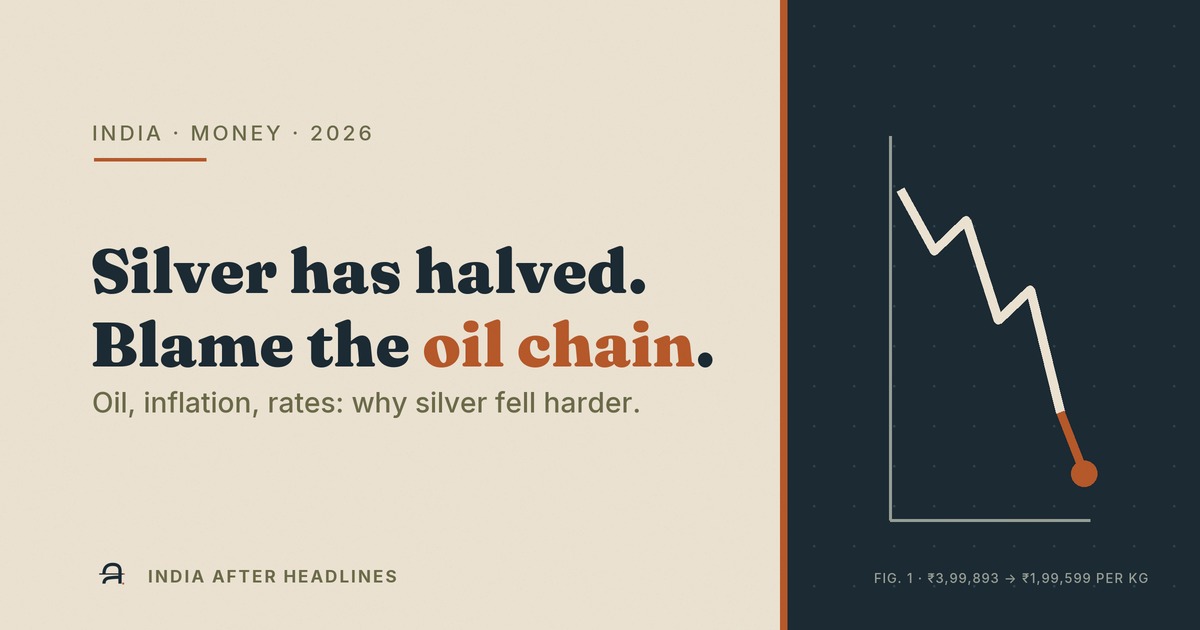
Why Has Silver Halved in 2026? From ₹4 Lakh to ₹2 Lakh a Kilo, Explained
Silver closed at half its January record on 22 October. It wasn't a scam or a collapse in demand for jewellery. It was a chain that started with crude oil.
PSU Bank Stake Sale 2026: Central Bank, UCO, IOB, Punjab & Sind — Is Your FD Safe?
After IDBI, the government wants to sell part of four more banks. That part isn't privatisation, and the legal cover on your deposit never depended on who owns the bank.