
Will Lab-Grown Gold Crash the Gold Price? No. Here's What to Check This Dhanteras Instead
Diamonds can be grown in a lab. Gold can't. The real fake-gold risk this Dhanteras is at the jewellery counter, and it takes two minutes to check.
Short answer: No. Lab-grown gold will not crash the gold price, because there is no such product. Diamonds can be grown in a lab because a diamond is just carbon in a pattern. Gold is an element: making it means changing one element into another, which so far has produced a few radioactive atoms at a cost far above gold’s price. Gold has fallen for an ordinary reason, from about ₹1,81,000 per 10 g in January 2026 to about ₹1,42,500 on 25 October. The real fake-gold risk this Dhanteras (6 November) is at the jewellery counter, and the HUID check settles it in two minutes.
The misconception: “lab gold is coming, so prices will collapse”
The fear borrows its logic from diamonds, where it came true. Lab-grown diamonds are chemically real diamonds, and once factories could make them, their price fell about 74% between 2020 and 2024. So it sounds reasonable that gold is next.
It isn’t. A diamond is carbon atoms arranged in a particular lattice, and a machine can build that lattice. Gold isn’t an arrangement of anything. It is element number 79, and the only way to make it is to change the nucleus of another element.
What “lab-made gold” actually is
It has been done. In 2025 CERN’s ALICE experiment turned lead into gold, producing a minuscule amount that you couldn’t see, that was radioactive, and that cost vastly more than gold to make. A US start-up, Marathon Fusion, has published a concept for turning mercury into gold inside a fusion reactor. That is a paper; not one gram has been made. A viral claim that “Chinese scientists made artificial gold” traces back to 2018.
So the price chart has nothing to fear from the laboratory. It has plenty to fear from interest rates.
Why gold actually fell
The chain is boring and well-documented: costlier oil feeds inflation fears, inflation fears raise the odds of higher interest rates, and higher rates make fixed deposits and bonds more attractive. Gold pays no interest, so money leaves it. That’s how 24-carat gold went from about ₹1,81,000 per 10 g at its January record, to about ₹1,45,100 a week ago, to about ₹1,42,500 on 25 October (rates vary by city and exclude GST).
The real fake-gold risk: the counter, not the lab
The jewellery you buy this week won’t be lab-grown. It might be under-karat: sold as 22 carat when it’s less, or plated over something cheaper. That’s the fake worth worrying about.
Every hallmarked piece carries a 6-character HUID (Hallmark Unique ID), effectively an Aadhaar number for that one item. Since 1 April 2023 a jeweller can’t sell hallmarked jewellery without it. Open the BIS Care app from the Bureau of Indian Standards, tap Verify HUID and type in the code. It shows the purity, the jeweller’s registration and the centre that tested it. If it doesn’t match your bill, don’t pay. Check the code before you pay, not after.
The twist: there’s gold in your drawer
Old phones, a dead laptop and broken chargers all use gold in their circuits, because it never rusts and carries current well. A tonne of old circuit boards holds 30–100 grams of gold, more than the rock in many working mines.
Before you start dismantling things: one phone holds only about 24–34 milligrams, roughly ₹350–500 at today’s price. Getting it out takes acid and fire and gives off toxic fumes, so don’t try it at home. Worldwide, only about 22% of e-waste is documented as properly recycled; the rest is burned or buried.
Science is catching up. At ETH Zurich, a sponge made from whey, the liquid left over from cheese-making, pulled a 22-carat nugget out of 20 old motherboards. In August 2026 a University of Illinois team reported a molecule that uses electricity to separate gold from e-waste with 10 to 100 times fewer chemicals.
Also this week: ₹14 crore vanished from a government bank’s RBI account
Central Bank of India has told Mumbai police that ₹13.97 crore left its settlement account with the RBI through 187 unauthorised transfers between 15 and 17 October, into 36 accounts. According to the FIR, unknown persons got into SFMS, the messaging system that carries NEFT and RTGS instructions between banks and is run by IFTAS, a company owned by the RBI, through the bank’s own system. The bank says it found none of the 187 transactions in any branch, app or internal record. The case is under investigation.
No customer’s account was involved; the money left the bank’s own account. If money ever leaves your account without you, report it to your bank within three working days. If the fault isn’t yours, your liability is zero, and the bank is expected to put the money back within ten working days. In 2024 the RBI fined Central Bank ₹1.45 crore, partly for missing that deadline.
What to actually do
- Buying this Dhanteras? Verify the HUID in the BIS Care app before you pay.
- Don’t panic-sell over “lab gold”. The fear has no basis.
- Old phones and laptops: use the brand’s take-back scheme or a recycler on the CPCB’s authorised list, never the scrap dealer who burns them.
- Check your bank statement once a month, and report anything you don’t recognise the same day.
The richest gold mine in India might be your drawer. The second richest is the gap between what a hallmark says and what you paid for.
Take action
Sources
- 24-carat gold rates, 25 October 2026 (Candere, goldpriceindia.com); January 2026 record of about ₹1,81,000–1,83,050 per 10 g (Forbes India, allindiabullion)
- Black Dot Research — fact-check on 'lab-grown gold': CERN ALICE lead-to-gold transmutation (May 2025) and Marathon Fusion's mercury-to-gold concept paper (2025)
- Fortune, January 2025 — lab-grown diamond prices down about 74% between 2020 and 2024 (citing The Guardian)
- Bureau of Indian Standards / Ministry of Consumer Affairs — sale of hallmarked jewellery without the 6-character HUID barred after 31 March 2023
- Futura-Sciences and World Economic Forum — gold content of circuit boards (30–100 g per tonne)
- ETH Zurich (Mezzenga group), Advanced Materials, 2024 — whey-protein sponge recovering a 22-carat gold nugget from 20 motherboards
- University of Illinois Urbana-Champaign (Xiao Su group), ACS Energy Letters, August 2026 — electricity-driven gold recovery with 10–100x fewer chemicals
- UN Global E-waste Monitor 2024 — 62 million tonnes of e-waste in 2022, 22.3% documented as properly recycled
- Hindustan Times, October 2026 — Central Bank of India FIR on ₹13.97 crore siphoned via 187 unauthorised transfers
- Reserve Bank of India — customer-liability directions (July 2017) and 2024 penalty on Central Bank of India
Can gold be made in a lab?
Only a few atoms at a time, and at a cost far above gold's own price. Gold is a chemical element, so it can't be assembled the way a lab-grown diamond is. Making it means changing one element into another inside a particle accelerator or reactor. CERN did this with lead in 2025 and got a minuscule, radioactive amount. A US start-up has published a concept for turning mercury into gold, but it is a paper, not a product.
Will lab-grown gold make gold prices crash?
No. There is no commercial lab-grown gold, and nothing on the horizon that could produce it cheaply. The comparison comes from diamonds: lab-grown diamonds are real diamonds made from carbon, and their price fell about 74% between 2020 and 2024. Gold doesn't work that way.
Why did gold fall before Dhanteras 2026?
24-carat gold was about ₹1,81,000 per 10 g at its January 2026 record and about ₹1,42,500 on 25 October. The usual chain is at work: costlier oil raises fears of higher interest rates, money moves to fixed deposits and bonds that pay interest, and gold, which pays none, loses buyers.
How do I check if my gold jewellery is real?
Find the 6-character HUID (Hallmark Unique ID) stamped on the piece. Open the government's BIS Care app, tap Verify HUID and enter the code. It shows the purity, the jeweller's registration and where the piece was tested. If it doesn't match the bill, don't pay.
Is there really gold in old phones?
Yes, but not much per phone: roughly 24–34 milligrams, worth about ₹350–500 at today's price. A tonne of old circuit boards holds 30–100 grams, richer than many mines. Don't try to extract it at home; it needs acid and fire and releases toxic fumes. Give old devices to the brand's take-back scheme or a recycler on the Central Pollution Control Board's authorised list.
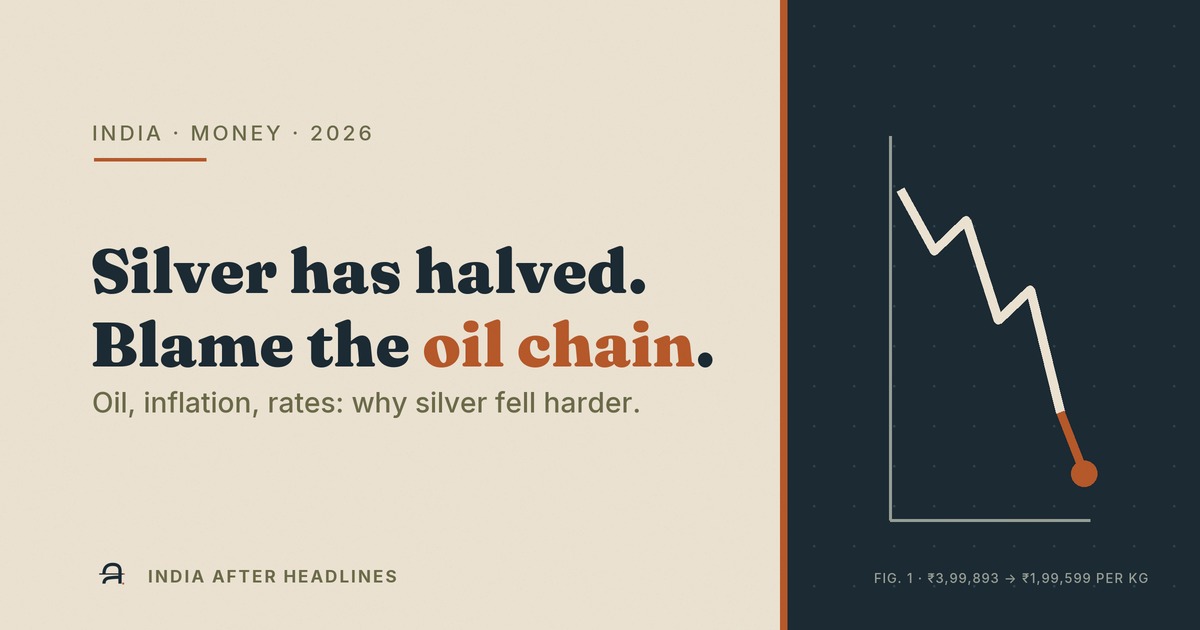
Why Has Silver Halved in 2026? From ₹4 Lakh to ₹2 Lakh a Kilo, Explained
Silver closed at half its January record on 22 October. It wasn't a scam or a collapse in demand for jewellery. It was a chain that started with crude oil.
PSU Bank Stake Sale 2026: Central Bank, UCO, IOB, Punjab & Sind — Is Your FD Safe?
After IDBI, the government wants to sell part of four more banks. That part isn't privatisation, and the legal cover on your deposit never depended on who owns the bank.
SBI Data Leak 2026: What Actually Leaked, What Didn't — and the Call You Should Expect
SBI has confirmed customer data is on the dark web. It can't open your account. It can make a stranger sound exactly like your bank.