
PSU Bank Stake Sale 2026: Central Bank, UCO, IOB, Punjab & Sind — Is Your FD Safe?
After IDBI, the government wants to sell part of four more banks. That part isn't privatisation, and the legal cover on your deposit never depended on who owns the bank.
Short answer: Your FD is as safe as it was yesterday. The government is considering cutting its stake in Central Bank of India, UCO Bank, Punjab & Sind Bank and Indian Overseas Bank to 75%. A bank that is 75% government-owned is still a government bank. The bigger point is that whoever owns your bank, the law guarantees the same thing on your deposit: ₹5 lakh per depositor per bank, through DICGC.
The misconception: “my bank is being sold”
Two pieces of news arrived a week apart and got blended into one scary headline. First, in mid-October the Cabinet approved selling 60.72% of IDBI Bank to Fairfax Financial, Prem Watsa’s Canadian group, for ₹52,878 crore. That one really is a change of owner.
Then, on 23 October, the Economic Times reported that the government wants to bring its stake in four more banks down to 75%. Today it owns 81% of Central Bank, about 91% of UCO, about 92% of IOB and about 94% of Punjab & Sind. The reason is a stock-market rule: at least 25% of a listed company should be held by the public. The government is not leaving these banks. It is making room for other shareholders.
Where privatisation actually sits
The same report adds that a new consolidation round could identify two more state banks for privatisation. They haven’t been named or chosen. Earlier reports said NITI Aayog had shortlisted Central Bank and IOB, but nothing has been decided. The privatisation also needs Parliament to amend a 1970 law, the Banking Companies (Acquisition and Transfer of Undertakings) Act. Expect years.
The twist: the guarantee you thought you had
Most savers keep a simple rule in their heads: government bank, totally safe; private bank, a bit risky. The law doesn’t draw that line. DICGC, the RBI subsidiary that insures deposits, covers ₹5 lakh per depositor per bank, interest included. The cover is identical for a public sector bank and a private one.
“The government will never let its own bank fail” is a reasonable expectation. It is not a legal promise. A change of owner changes that expectation. It doesn’t change your account number, your FD or your IFSC.
Private doesn’t mean doomed either. When Yes Bank and Lakshmi Vilas Bank got into trouble in 2020, the RBI arranged a rescue and a merger, and depositors did not lose their money.
What to actually do
- Don’t panic-withdraw. Breaking an FD early usually costs a penalty, and nothing in your account changed today.
- Use the ₹5 lakh rule. Keep each person’s money in any one bank at or below ₹5 lakh, principal plus interest. If you hold more, split it across banks or across family members’ own accounts.
- If your bank changes hands, read the new schedule of charges. If minimum balances or fees change and you don’t like them, moving your money is your right.
Also this week: GST changes from 1 November
For small traders and online sellers, the GST Council’s process reforms start rolling out in phases from 1 November 2026. Small e-commerce sellers get easier registration, and refunds will be sanctioned automatically, though only for new claims, not ones already pending. Businesses selling only to consumers with turnover under ₹5 crore have in-principle approval for one return a year with quarterly tax payments. From 1 April 2027, after the law is amended, no show-cause notice will be issued for amounts under ₹10,000.
Take action
Sources
- The Economic Times — report of 23 October 2026 on stake cuts in four PSU banks (as reported by Moneycontrol and Fortune India, 23 Oct 2026)
- Fortune India — After IDBI Bank deal, govt weighs stake cuts in Central Bank, UCO Bank and 2 other PSU lenders (23 Oct 2026)
- BusinessLine — CCEA approves IDBI Bank stake sale to Fairfax for ₹52,878 crore (16 Oct 2026)
- Deposit Insurance and Credit Guarantee Corporation (DICGC) — deposit insurance coverage of ₹5 lakh per depositor per bank
- Reserve Bank of India — Yes Bank reconstruction scheme (March 2020) and Lakshmi Vilas Bank amalgamation with DBS Bank India (November 2020)
- Moneycontrol — GST reforms to be rolled out in phases from November 1, says CBIC member (22 Oct 2026)
Is the government privatising Central Bank, UCO Bank, IOB and Punjab & Sind Bank?
Not with this move. According to an Economic Times report of 23 October 2026, the government is considering cutting its stake in these four banks to 75% to meet the minimum public shareholding rule. At 75% the government remains the majority owner, so the banks stay state-run.
Which banks will be privatised next?
None has been named. The same report says a new consolidation round could identify two more state banks for privatisation. That would need Parliament to amend the Banking Companies (Acquisition and Transfer of Undertakings) Act, so it is a multi-year process, not an imminent sale.
What happened with IDBI Bank?
In October 2026 the Cabinet Committee on Economic Affairs approved the sale of a 60.72% stake in IDBI Bank (30.48% from the government, 30.24% from LIC) to an arm of Fairfax Financial Holdings for ₹52,878 crore, at ₹81 a share.
Is my money safer in a government bank than a private bank?
Legally, no. DICGC insures deposits up to ₹5 lakh per depositor per bank, principal and interest together, and that limit is the same for public sector and private banks. The belief that the government will always rescue its own bank is an expectation, not a statutory guarantee.
Should I withdraw my FD from these banks?
There is no reason to panic-withdraw. Breaking an FD early usually costs a penalty, and nothing about your account, FD or IFSC changes because the shareholding changes. The sensible step is to keep your balance in any one bank, in one name, within ₹5 lakh including interest.
Why Has Silver Halved in 2026? From ₹4 Lakh to ₹2 Lakh a Kilo, Explained
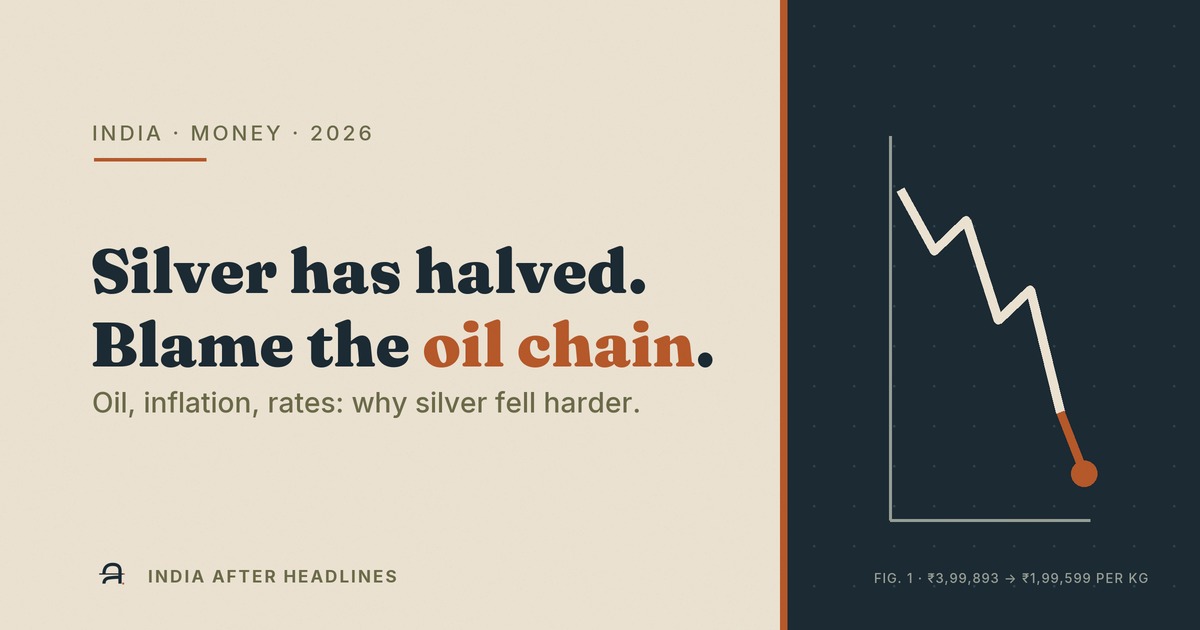
Silver closed at half its January record on 22 October. It wasn't a scam or a collapse in demand for jewellery. It was a chain that started with crude oil.
SBI Data Leak 2026: What Actually Leaked, What Didn't — and the Call You Should Expect
SBI has confirmed customer data is on the dark web. It can't open your account. It can make a stranger sound exactly like your bank.
UPI Charge Above ₹2,000: Deferred Till After Diwali — and Who Actually Pays It
The 0.4% fee on some UPI shop payments above ₹2,000 was due on 15 October 2026. NPCI has pushed it to after Diwali. When it comes, it is the shop's fee, not yours.