
Why Does the Same Medicine Cost 12 Times More in a Hospital? The Supreme Court Asked Too
A chemotherapy injection that a dealer sells for ₹11,000 was billed at ₹1,30,000. On 27 October the Supreme Court called it loot. Here is how the markup works, and why the rules don't stop it.
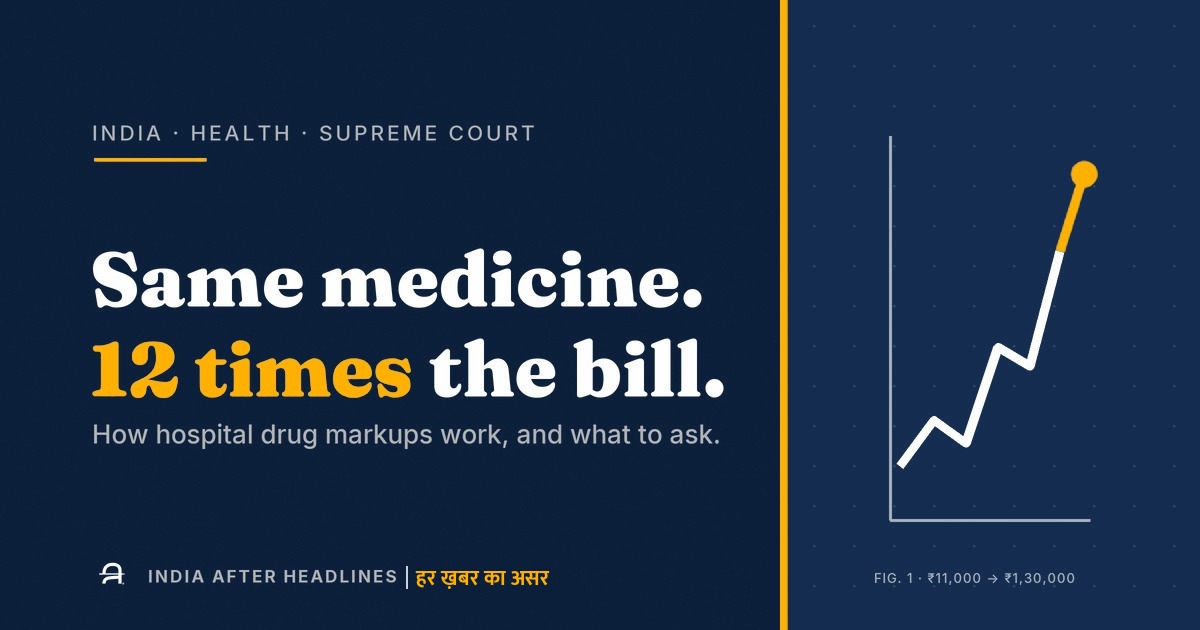
Short answer: Because the price printed on the pack is not the price the hospital paid. For most medicines the company sets the MRP (maximum retail price) itself, the hospital buys far below it, and you pay the full MRP. On 27 October 2026 the Supreme Court heard a case where a chemotherapy injection with a dealer price of ₹11,000 was billed at ₹1,30,000, about 12 times, and asked the government: “Can you justify this loot?”
The misconception: “hospitals are breaking the law”
It is natural to assume a 12x bill must be illegal. Mostly, it is not. The court heard several examples: the ₹11,000 injection billed at ₹1,30,000, a saline drip line bought for ₹15 and billed at ₹250, and at an earlier hearing on 29 September, a cancer drug supplied to retailers at ₹2,700 carrying an MRP of ₹27,000. Each of those bills can stay at or under MRP. The markup lives inside the MRP itself.
How the markup actually works
- The company prints a high MRP. For most medicines nobody caps the starting MRP.
- The hospital buys cheap. Its purchase price can be a fraction of the MRP.
- The pharmacy rule. Some hospitals insist you buy only from their own pharmacy, a practice the court has asked the government to examine.
- You pay the full MRP. The gap between the purchase price and the MRP is the hospital’s margin.
Why nobody stops it: two gaps in the rules
The rules exist. They just have holes.
Gap 1: medicine prices. The Drugs (Prices Control) Order, 2013 fixes a ceiling price only for medicines on the essential list. For everything else, it only says the MRP can rise by at most 10% a year. It says nothing about how high the MRP can start. The court said nearly 90% of medicines sit outside price control.
Gap 2: hospital charges. The Clinical Establishments Act, 2010 and Rule 9 of its 2012 rules say hospitals should display their rates and charge within a range set by the Centre with the states. Only 12 states and 7 union territories adopted the Act, and that rate range has still not been fixed. In 2024 the Supreme Court pulled up the Centre over exactly this.
So this is not one bad actor. It is a system gap that hospitals use, legally.
The twist: the fix is on the table, but undecided
The government told the court it would cap the trade margin on anti-cancer drugs at 30% of MRP. The court had already asked why a 16% margin should not apply to all medicines. Private hospitals argued that lower margins would make them shut down; the bench did not accept that as a justification. The court has reserved its verdict, so nothing has changed on your bill yet.
What to actually do
- Ask for the salt name. Get the generic (salt) name of any expensive medicine written down and check its price at an outside chemist or a Jan Aushadhi store.
- Get refusals in writing. If the hospital refuses medicine bought outside, ask for the reason in writing.
- Ask for an itemised bill. At discharge, ask for every item priced separately, and match each medicine against its MRP and batch number.
The bill is not the price. Ask.
Take action
Sources
- Bar & Bench — 'Can you justify this loot?' Supreme Court slams hospitals, government for 1,000% mark-up on cancer drugs (27 Oct 2026)
- ThePrint — SC castigates Centre over medicine overpricing, asks 'can you justify this loot' (27 Oct 2026)
- Business Today — 'This is carnage': SC questions ₹27,000 MRP on ₹2,700 cancer drug at corporate hospital (29 Sep 2026)
- Telangana Today — Supreme Court flags 10-fold markup on cancer drugs, seeks uniform 16% margin (29 Sep 2026)
- Drugs (Prices Control) Order, 2013, issued under Section 3 of the Essential Commodities Act, 1955
- LiveLaw — Supreme Court asks Centre why range of rates for hospital services is not specified under the Clinical Establishments Rules (2024)
What did the Supreme Court say about hospital medicine prices?
On 27 October 2026 a bench of Justices Vikram Nath and Sandeep Mehta heard a man whose wife's chemotherapy injection cost ₹11,000 at dealer price but was billed at ₹1,30,000 by a private hospital. The bench asked the government whether it could justify 'this loot'. It also noted a saline drip line bought for ₹15 and billed at ₹250. The court has reserved its verdict.
Is it legal for a hospital to charge the full MRP?
Yes. MRP is the maximum retail price, and charging up to it is allowed. The problem is that for most medicines the company sets the MRP itself, so it can be many times the price the hospital actually pays.
Doesn't the government control medicine prices?
Only partly. Under the Drugs (Prices Control) Order, 2013, medicines on the National List of Essential Medicines get a ceiling price. For the rest, the order only limits how much the MRP can rise each year (10%). It does not cap the MRP a company sets at launch. The court said nearly 90% of medicines fall outside price control.
What is the 30% vs 16% debate?
The government told the court it would cap the trade margin, the cut taken by sellers along the chain, at 30% of MRP for anti-cancer drugs. At an earlier hearing on 29 September, the court had asked why a uniform 16% margin should not apply to all medicines. No decision has been made yet.
Can a hospital force me to buy medicines from its own pharmacy?
The Supreme Court has asked the government to examine complaints that hospitals do this. If a hospital refuses medicine bought outside, ask it to give the reason in writing.
Lost Money to a Cyber Fraud? Your Bank May Have to Pay It Back
On 29 October the Supreme Court told the RBI that banks must repay fraud victims when their own checks fail. It is not law yet. But a 2017 RBI rule already protects you, if you move within three days.
Fake E-Challan SMS: How Scammers Know Your Vehicle Number, and How to Check in 30 Seconds
The fine is invented. The vehicle number in it is not. Here's where that number comes from, and the one check that settles it.
Are Cancer Medicines Getting Cheaper in India? Yes, From 9 November — If You Check
The government has capped what middlemen can add to 137 cancer drugs. Prices should fall 20 to 70% from 9 November. Almost nobody paying for chemotherapy has heard about it.