
Lost Money to a Cyber Fraud? Your Bank May Have to Pay It Back
On 29 October the Supreme Court told the RBI that banks must repay fraud victims when their own checks fail. It is not law yet. But a 2017 RBI rule already protects you, if you move within three days.
Short answer: Sometimes, yes, and soon possibly more often. On 29 October 2026 the Supreme Court told the RBI that its coming anti-fraud rules must make banks repay victims, no less than the amount lost, when the bank’s own checks failed. That is not law yet. But an RBI rule from 2017 already says that if the fraud was the bank’s lapse or a third-party breach and you report within three working days, you owe nothing, and the bank must put the money back within ten working days while it investigates.
The misconception: “once the money’s gone, it’s your problem”
Most victims hear some version of this at the branch: you were careless, we can’t help. Sometimes that’s true. Often it’s a bluff. Under the 2017 rule, it’s the bank that has to prove you were at fault, not you.
What the Supreme Court actually said
The bench was hearing the suo motu case on digital arrest scams, where a fake officer on a video call “arrests” you and makes you pay to make it go away. The court said the RBI’s draft rules should:
- make banks compensate victims where a failure of due diligence caused the loss;
- let banks temporarily hold transactions that don’t fit a customer’s usual pattern;
- add automated alerts and physical verification;
- have banks alert nearby police when a transfer looks like a digital arrest in progress.
Picture a pensioner whose account sees one withdrawal a month. One afternoon it sends ₹40 lakh to an account it has never paid before. The court’s point: a bank’s system can see that. If it waves the transfer through, it should share the cost.
The court will vet the RBI’s draft before it is notified. There is no date. Some reports mention possible prosecution of banks; that wording is unclear, so we’re leaving it out until the order is published.
The catch
If you shared your OTP or PIN yourself, the 2017 rule calls that negligence and you carry the loss until you report it. The new push is about the cases where the bank should have stopped the transfer even so. That’s a narrower door than the headlines suggest, but it’s a real one.
The rule nobody reads: 6 July 2017
| You report within | Your liability |
|---|---|
| 3 working days (bank lapse or third-party breach) | Zero |
| 4–7 working days | Limited, capped |
| After 7 working days | As per the bank’s board-approved policy |
The bank must credit the disputed amount within ten working days of your complaint. The fine print, in other words, is on your side. It just isn’t printed anywhere you’d look.
What to do if it happens
- Block first. Call your bank’s helpline and block your card, UPI and net banking.
- Call 1930, the national cyber-fraud helpline. Early calls can freeze money in transit.
- Email the bank the same day. Write “RBI circular dated 6 July 2017” in the complaint and keep the acknowledgement number.
- File at cybercrime.gov.in.
- Escalate after 30 days. If the bank rejects the complaint or doesn’t reply, complain to the RBI Ombudsman at cms.rbi.org.in. It’s free.
The clock starts the moment the money leaves. Every day you wait, the rule protects you a little less.
Take action
Sources
- Business Standard — SC asks RBI to make banks compensate victims of digital arrest, cyber fraud (29 Oct 2026)
- Bar & Bench — Supreme Court to vet RBI's digital fraud regulations before notification, says banks must compensate victims (29 Oct 2026)
- Outlook — Banks must compensate fraud victims if due diligence fails: Supreme Court (29 Oct 2026)
- RBI circular DBR.No.Leg.BC.78/09.07.005/2017-18, Customer Protection — Limiting Liability of Customers in Unauthorised Electronic Banking Transactions (6 July 2017)
- Reserve Bank – Integrated Ombudsman Scheme, 2021
What did the Supreme Court say on 29 October 2026?
A bench of Chief Justice Surya Kant, Justice Joymalya Bagchi and Justice V Mohana, hearing the suo motu case on digital-arrest scams, said the RBI's proposed anti-fraud rules must require banks to compensate victims, with no less than the amount lost, where a failure of the bank's due diligence caused the fraud. The court will examine the RBI's draft before it is notified.
Is this a law now?
No. It is a direction on what the RBI's coming rules should contain. No final rule or date has been announced.
What is a digital arrest?
A scam in which someone on a video call poses as police, CBI or customs, tells you that you are under arrest, keeps you on camera for hours, and pressures you to transfer money to 'clear your name'. No real agency arrests anyone over a video call.
What protection exists today?
Under the RBI's 6 July 2017 circular, if an unauthorised electronic transaction happens because of the bank's own lapse, or a third-party breach where neither you nor the bank was at fault and you report it within three working days, your liability is zero. If you report in four to seven working days your liability is limited and capped. The bank must credit the disputed amount to your account within ten working days of your complaint, and the burden of proving that you were at fault lies on the bank.
What if I shared my OTP?
Under the 2017 circular, sharing your OTP or PIN counts as negligence, and you bear the loss until you report it. The Supreme Court's push is aimed at cases where the bank should have caught an unusual transaction anyway.
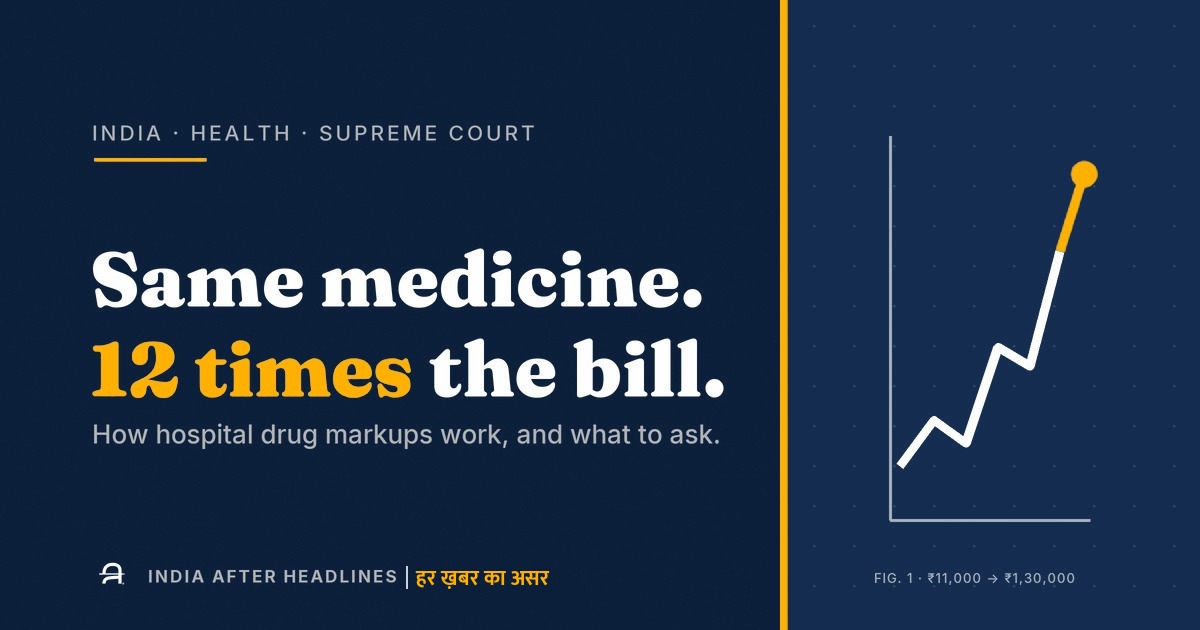
Why Does the Same Medicine Cost 12 Times More in a Hospital? The Supreme Court Asked Too
A chemotherapy injection that a dealer sells for ₹11,000 was billed at ₹1,30,000. On 27 October the Supreme Court called it loot. Here is how the markup works, and why the rules don't stop it.
Fake E-Challan SMS: How Scammers Know Your Vehicle Number, and How to Check in 30 Seconds
The fine is invented. The vehicle number in it is not. Here's where that number comes from, and the one check that settles it.

Are Cancer Medicines Getting Cheaper in India? Yes, From 9 November — If You Check
The government has capped what middlemen can add to 137 cancer drugs. Prices should fall 20 to 70% from 9 November. Almost nobody paying for chemotherapy has heard about it.