
Petrol Just Got ₹5 Cheaper in India — for the First Time in 2 Years. So Why Is Your Pump Still Charging ₹102?
Crude crashed 24% in a month. One retailer cut prices. The pumps 9 out of 10 of us use didn't move a paisa. The gap between those two facts is the whole story.
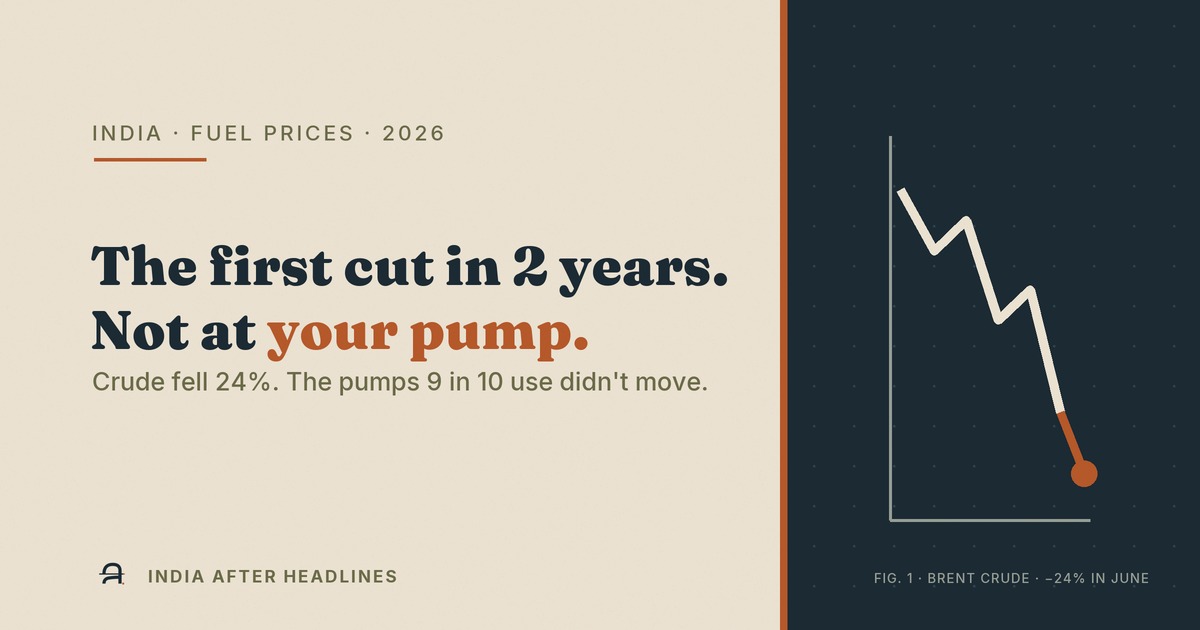
Short answer: On 1 July 2026, Nayara Energy — India’s largest private fuel retailer, with over 7,000 pumps — cut petrol by ₹5 per litre and diesel by ₹3, reportedly the first retail fuel price cut by any company in India in more than 2 years, after Brent crude fell about 24% in June to roughly $72 a barrel. But IOC, BPCL and HPCL, who run over 90% of India’s 1 lakh+ pumps, changed nothing — Delhi petrol is still ₹102.12, Mumbai ₹111.21. Whether the crude crash ever reaches your pump now hangs on two decisions: whether the government restores the ~₹10/litre excise duty it cut on 27 March 2026, and whether the state-run companies pass the savings on or keep them to recover past losses.
The cut is real. The catch is the address
The popular version of this week’s news — “petrol got cheaper” — is about 7% true.
Here’s the precise version. From 1 July, Nayara Energy reduced petrol by ₹5 and diesel by ₹3 per litre nationwide (exact prices vary with state taxes). Nayara runs more than 7,000 pumps and is Rosneft-backed — a fact, not a plot point. Reports describe this as the first retail fuel price cut by any Indian fuel retailer in over 2 years; reports also note it effectively reverses Nayara’s own price increase from March, which is part of the truth too.
Meanwhile IOC, BPCL and HPCL — the three state-run companies behind more than 90% of the country’s 1 lakh+ fuel stations — announced no revision. Their last move was on 25 May 2026, when petrol went up ₹2.61 and diesel ₹2.71. So since 1 July, India has two kinds of pumps: one where petrol is ₹5 cheaper, and the 90%+ where nothing happened. Statistically, yours is in the second kind.
Why prices fell at all
Crude. Brent dropped roughly 24% in June 2026 — WTI about 26% — as West Asia tensions eased and the Strait of Hormuz shipping route reopened, restoring oil and gas flows. Brent settled around $72 a barrel on 1 July. When your raw material gets a quarter cheaper in a month, the retail price should follow. One retailer let it. The obvious question is why the other 90% didn’t — and the answer isn’t a villain, it’s a mechanism.
The two places relief gets intercepted
Cheaper crude doesn’t travel straight from Rotterdam to your fuel tank. It passes two toll booths.
Booth one: the excise decision. On 27 March 2026, with crude sky-high, the government cut central excise on petrol from ₹13 to ₹3 per litre and on diesel to zero — a shield of roughly ₹10/litre that stopped pump prices from exploding. Pump prices didn’t fall then either; the cut absorbed the oil companies’ under-recoveries. That shield genuinely worked, and it deserves the credit. But now crude has fallen, and the same lever swings the other way: the government can let cheap crude flow through to the pump, or restore the excise and recover its ₹10. Both are legitimate fiscal choices. Only one of them reaches your pocket.
Booth two: the oil companies’ ledgers. When crude was above $100, the state-run companies ate heavy per-litre losses. It’s fair that they’d want to rebuild those margins before cutting prices. The stock market has already done the math: on 2 July, BPCL, HPCL and IOC shares rose up to 4%. Translation from market-speak — cheaper crude is expected to become their profit before it becomes your cheaper petrol.
Cheap oil has arrived in India. The open question is who gets to keep it.
Same pattern, second fuel
This isn’t petrol-specific. On the same 1 July, the commercial 19-kg LPG cylinder — hotels, restaurants — fell ₹173–183, the first cut of 2026; Delhi’s is now ₹2,930. Your household 14.2-kg cylinder? ₹942 in Delhi, unchanged to the paisa. Relief reaching businesses, pausing before households: the mechanism doesn’t even bother to vary its routine.
Why this time is different
For two years the standoff was invisible — no one cut, so no one had to explain not cutting. Now one private player has put a ₹5 gap on public display at 7,000+ pumps. When one station sells petrol near ₹97 and the one down the road sells it at ₹102, that difference isn’t a policy debate anymore. It’s a signboard. Pressure that used to live in editorials now lives on the roadside, and it’s measurable by anyone with a bike.
What to do
- Check for a Nayara pump near you. 7,000+ outlets, locator on the company’s website. If one’s nearby, your ₹5/litre saving starts now — no headline required.
- Watch for one line: “OMCs revise fuel prices.” The day IOC, BPCL and HPCL move, the relief goes mainstream. It’ll be printed small; it’s the real news.
- Listen for the words “excise duty.” If the 27 March cut gets rolled back in a budget or notification, the crude crash was intercepted before your pump. Nobody announces it in those words — but now you can read it yourself.
- Don’t repeat “petrol got cheaper” flatly. It got cheaper at roughly 7% of pumps. Precision is the whole game here — it’s also how you’ll know when the other 93% finally blink.
Sources
- Autocar India — Nayara reduces petrol, diesel prices by up to ₹5 per litre (autocarindia.com)
- The Federal — Nayara Energy petrol-diesel price cut, first in over 2 years (thefederal.com)
- News9live — Nayara slashes petrol ₹5, diesel ₹3; will IOC/HPCL/BPCL follow? (news9live.com)
- BusinessToday — Petrol, diesel prices 1 July 2026: Delhi, Mumbai unchanged (businesstoday.in)
- BusinessToday — BPCL, HPCL, IOC shares gain up to 4% on 2 July 2026 (businesstoday.in)
- Deccan Herald — Commercial 19-kg LPG cut ₹183.50; Delhi cylinder now ₹2,930 (deccanherald.com)
- PIB — Central excise duty cut on petrol and diesel, 27 March 2026 (pib.gov.in)
- Fortune — Brent crude near $72/barrel, ~24% fall in June 2026 (fortune.com)
Did petrol prices come down in India in July 2026?
At some pumps, yes. From 1 July 2026, Nayara Energy — India's largest private fuel retailer, with over 7,000 pumps — cut petrol by ₹5 per litre and diesel by ₹3. Reports call it the first retail fuel price cut by any company in more than 2 years. IOC, BPCL and HPCL, which run over 90% of India's pumps, made no change.
Why didn't IOC, BPCL and HPCL cut petrol prices when crude fell?
No official reason was given. The state-run companies absorbed heavy per-litre losses when crude was above $100, and markets expect them to use cheaper crude to rebuild margins first — their shares rose up to 4% on 2 July 2026. There is also a pending question of whether the government restores the ~₹10/litre excise duty it cut on 27 March 2026.
When will petrol become cheaper at all pumps in India?
Watch two triggers: an announcement that the state-run OMCs are revising retail prices, and any decision on restoring the central excise duty cut of 27 March 2026. If excise goes back up, much of crude's fall gets absorbed before it reaches the pump.
What is the petrol price in Delhi and Mumbai now?
At the state-run pumps, unchanged: Delhi petrol ₹102.12/litre and diesel ₹95.20; Mumbai petrol ₹111.21 and diesel ₹97.83 — steady since a ₹2.61/₹2.71 hike on 25 May 2026. Nayara pumps are ₹5 lower on petrol from 1 July.
Did LPG cylinder prices fall in July 2026?
Only commercial ones. The 19-kg commercial cylinder fell ₹173–183 on 1 July 2026 — Delhi is now ₹2,930 — the first cut of 2026. The domestic 14.2-kg cylinder is unchanged at ₹942 in Delhi.
Will Lab-Grown Gold Crash the Gold Price? No. Here's What to Check This Dhanteras Instead
Diamonds can be grown in a lab. Gold can't. The real fake-gold risk this Dhanteras is at the jewellery counter, and it takes two minutes to check.
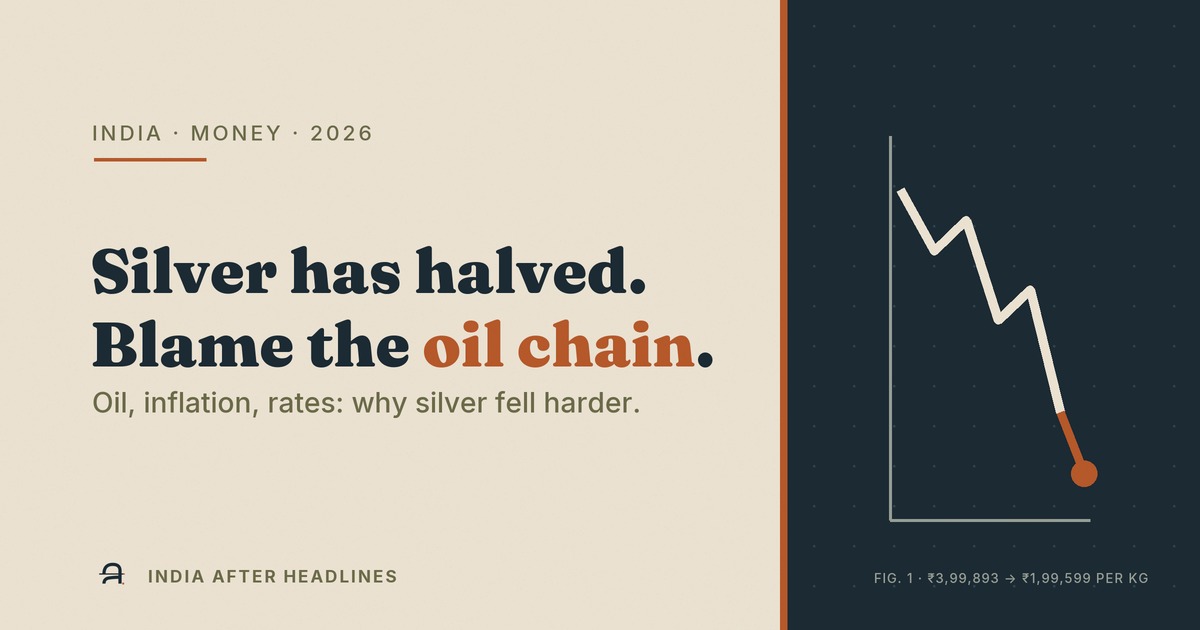
Why Has Silver Halved in 2026? From ₹4 Lakh to ₹2 Lakh a Kilo, Explained
Silver closed at half its January record on 22 October. It wasn't a scam or a collapse in demand for jewellery. It was a chain that started with crude oil.
PSU Bank Stake Sale 2026: Central Bank, UCO, IOB, Punjab & Sind — Is Your FD Safe?
After IDBI, the government wants to sell part of four more banks. That part isn't privatisation, and the legal cover on your deposit never depended on who owns the bank.