
India-US Trade Deal Is 'Very Close' — So Why Hasn't It Been Signed?
Both sides want it. Nobody will sign it. The clock runs out on July 24.
Short answer: The deal is not signed. Commerce Minister Piyush Goyal said on 25 June 2026 that the India-US trade deal is “very close” — but India will not sign until the US guarantees India a competitive tariff advantage over Vietnam and Bangladesh. The temporary 10% US tariff under Section 122 expires on July 24, 2026. If no final deal is inked by then, the tariff regime resets and export-linked jobs, prices, and market sentiment take the hit.
”Very close” is not a destination
Two words have done more diplomatic heavy-lifting this month than most entire speeches. “Very close.” USTR Jamieson Greer flew to New Delhi from June 22 to 24 for face-to-face talks with Goyal. Three days of meetings. And the verdict? Very close.
Which, in trade-deal language, means: both sides need to show their public that progress is happening. It does not mean the pen has touched the paper.
What’s actually on the table
The February 2026 framework was ambitious. India agreed to cut tariffs on US industrial goods and agricultural products — tree nuts, soybean oil, wine, spirits, DDGs. In return, India committed to purchasing $500 billion of US energy, aircraft, technology, coking coal, and precious metals over five years.
India drew one hard line: dairy, spices, rice, wheat, and frozen vegetables stay protected. Indian farmers’ livelihoods depend on them, and that exclusion is not on the negotiating table.
So far, a deal both sides want. Which makes the next part worth reading slowly.
The catch nobody headlines
India’s condition is simple arithmetic. If the US sets the same 18% tariff on India, Vietnam, and Bangladesh, India loses. Indian goods cost more to make. At the same rate, buyers pick the cheaper supplier — and that’s not India.
Goyal’s exact words: “The day the US finds appropriate tools to give us a competitive advantage, the deal is on.”
India is not rejecting the deal. India is saying: give us a lower rate than our rivals, or the deal is just an expensive photo opportunity. Textiles, pharma, engineering products — the sectors where India competes directly with Vietnam and Bangladesh — need a visible edge.
The US, so far, has not found those “appropriate tools.”
The clock you should watch
July 24, 2026. Mark it.
In February, when the interim framework was agreed, the US imposed a temporary 10% tariff on all countries under Section 122 of the Trade Act. That tariff was meant as a bridge — 150 days for both sides to close the final deal.
Those 150 days expire on July 24. If no final deal is signed by then, the temporary 10% rate disappears. What replaces it? Nobody knows. Tariffs could snap back to higher levels. New rates could be imposed. The negotiating leverage shifts.
28 days remain.
What this means for your household
If you work in IT services, pharma exports, textile manufacturing, or engineering — this deal is directly about your job pipeline. A competitive tariff rate means more US orders flowing to India. Without it, those orders go to Dhaka and Ho Chi Minh City.
If the deal closes, the $500 billion purchase commitment opens a pipeline for cheaper energy and expanded technology access. Goldman Sachs raised India’s 2026 GDP forecast to 6.8% partly on this trade optimism. That’s the best-case scenario — and the trade deal is a load-bearing pillar of it.
The real villain
This is not a story about one minister holding out or one country being difficult. Both governments have done real work — the framework exists, the exclusions are clear, the purchase commitment is on the table, and meetings are happening on market access, digital trade, supply chain resilience, and non-tariff barriers.
The problem is structural. India needs a competitive position guaranteed before it signs away tariff protections. The US doesn’t yet have the mechanism to guarantee that. Two large economies, both doing exactly what they’re supposed to do — protect their own people — and in the process, leaving a deal that would help both sides sitting unsigned on a table with a ticking clock.
The system isn’t broken. It’s doing exactly what it was designed to do: protect everyone, and therefore serve no one fast enough.
Watch July 24. If a deal is announced before then, the growth story holds. If it isn’t, watch the US-facing order books of Indian exporters — they’ll tell you the truth before any headline does.
Take action
Sources
- PIB — USTR Jamieson Greer New Delhi bilateral trade talks, June 22–24, 2026
- Business Standard — 'India very close to trade deal with US, says Commerce Minister Goyal', 25 June 2026
- BusinessToday — 'Piyush Goyal says India-US trade deal very close but India won't sign until competitive advantage', 26 June 2026
- White House — Fact Sheet: The United States and India Announce Historic Trade Deal, February 2026
- Deccan Herald — 'No US deal until India gets competitive advantage: Goyal', June 2026
- Tribune India — 'US trade deal won't be implemented unless India gets tariff advantage over competitors: Goyal'
- Goldman Sachs — raises India CY26 GDP forecast to 6.8% after US-Iran deal, June 2026
Is the India-US trade deal signed?
No. As of 26 June 2026 the deal is unsigned. Commerce Minister Piyush Goyal said the deal is 'very close' but India will not sign until the US provides India a competitive tariff advantage over rival exporters like Vietnam and Bangladesh.
What is the July 24 2026 deadline?
In February 2026 the US imposed a temporary 10% tariff on all countries under Section 122 of the Trade Act, valid for 150 days. Those 150 days expire on July 24, 2026. If no final deal is signed by then, the temporary tariff regime ends and rates may reset unpredictably.
What did India agree to in the February 2026 framework?
India agreed to reduce or eliminate tariffs on US industrial goods and several agricultural products including tree nuts, soybean oil, wine, spirits, and DDGs. India excluded dairy, spices, rice, wheat, and select frozen vegetables to protect domestic farmers. India also committed to purchasing $500 billion of US energy, aircraft, technology, coking coal, and precious metals over five years.
Why won't India sign?
India wants its exports — textiles, pharma, engineering products — to face lower US tariffs than Vietnam and Bangladesh. At the same 18% tariff rate, India's naturally higher production costs mean Indian goods lose to cheaper Vietnamese and Bangladeshi alternatives. Goyal said: 'The day the US finds appropriate tools to give us a competitive advantage, the deal is on.'
How does this affect the common person?
If India gets a competitive rate, export orders grow and hiring in textile, pharma, and engineering sectors stays stable. If it doesn't, those orders go to Vietnam and Bangladesh. On the other side, the $500 billion purchase commitment opens a pipeline for cheaper energy and technology imports. Goldman Sachs raised India's 2026 GDP forecast to 6.8% partly on this trade optimism.
Will Lab-Grown Gold Crash the Gold Price? No. Here's What to Check This Dhanteras Instead
Diamonds can be grown in a lab. Gold can't. The real fake-gold risk this Dhanteras is at the jewellery counter, and it takes two minutes to check.
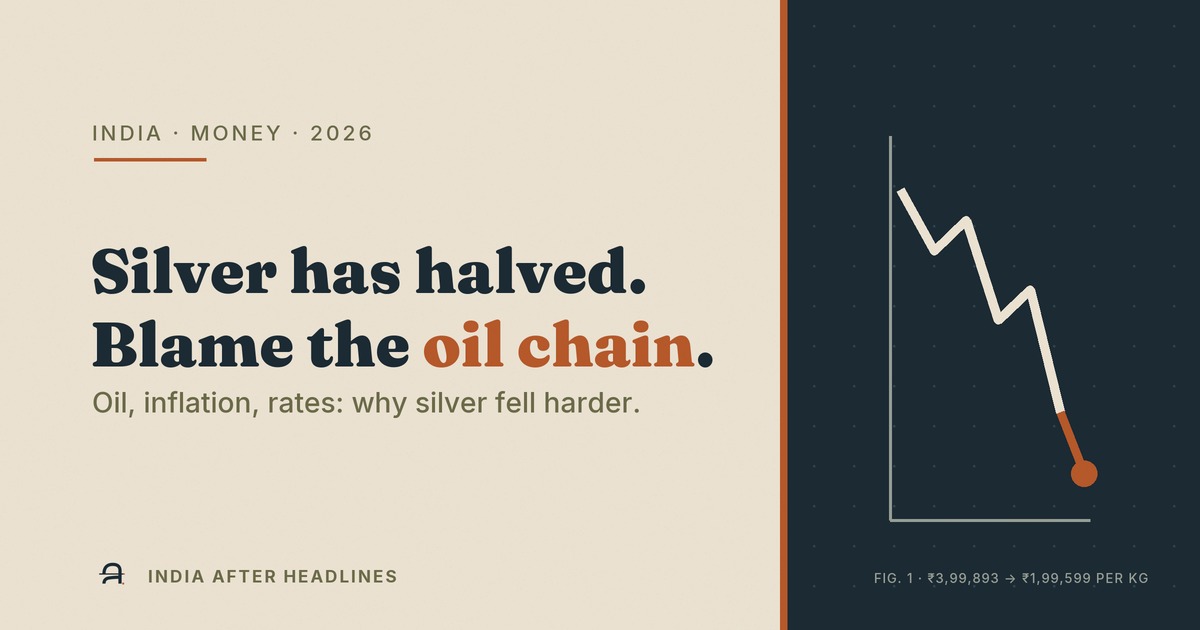
Why Has Silver Halved in 2026? From ₹4 Lakh to ₹2 Lakh a Kilo, Explained
Silver closed at half its January record on 22 October. It wasn't a scam or a collapse in demand for jewellery. It was a chain that started with crude oil.
PSU Bank Stake Sale 2026: Central Bank, UCO, IOB, Punjab & Sind — Is Your FD Safe?
After IDBI, the government wants to sell part of four more banks. That part isn't privatisation, and the legal cover on your deposit never depended on who owns the bank.