
El Niño and the 2026 Monsoon: Will Your Food Bill Really Rise?
Your vegetable bag costs ₹30–40 more and nobody at the market is to blame. The real culprit is an ocean you've never seen — and it hasn't even started yet.
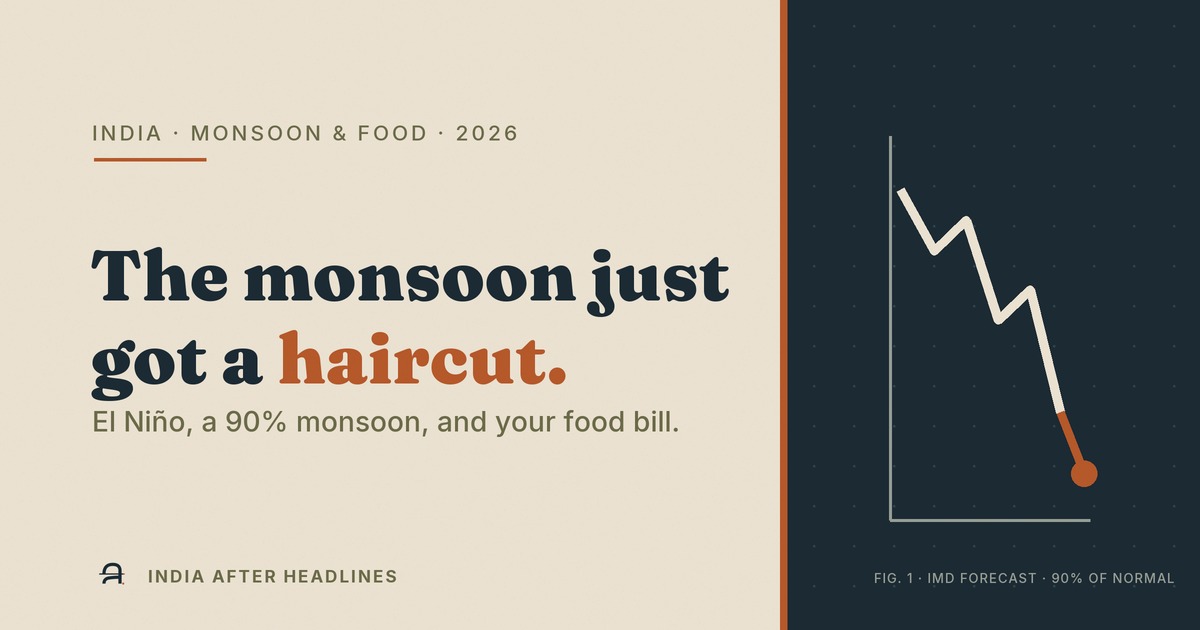
Short answer: Probably a little, and mostly later — but it is a risk, not a crisis. On 11 June 2026 the US agency NOAA confirmed El Niño is back, and on 12 June the IMD cut its 2026 monsoon forecast to 90% of the Long Period Average — officially “below-normal.” A weaker monsoon stresses India’s rain-fed kharif crops, which can tighten supply and lift food prices; May food inflation already hit 4.8%, a 16-month high. But the biggest rainfall shortfall is forecast for August–September, so this is a July-to-September story, not a June one — and El Niño is a tendency, not a guarantee. The last El Niño year still gave India a record harvest.
The receipt that didn’t add up
For the last two weeks the number has been there, but you probably didn’t stop on it. Same tomatoes, same onions, same fistful of coriander — and the bill came in ₹30 or ₹40 higher. You picked up flour; that was dearer too. It’s the season, you thought, and moved on.
So here’s the question worth stopping on: where did that extra money go? The easy suspects are the usual ones — the vendor, the middleman, the weather, the government. That’s where everyone points. But there’s a rule in any fair investigation: when every clue points at the same convenient suspect, you might be looking at the wrong one.
The evidence, laid out
Evidence one: May 2026 food inflation was 4.8%, up from 4.2% in April — the fastest food-price rise in 16 months. That’s an official figure, not your imagination. (Headline CPI for May was 3.93%.)
Evidence two: the monsoon reached Kerala on 4 June, about three days later than normal.
Evidence three — the strange one: India’s Agriculture Ministry quietly put roughly 197 districts on a watch list, monitored weekly, with drought-resistant seed and fertiliser reserves kept ready. Governments don’t pre-position seeds for a good year. Someone was bracing for something.
Beneath all three clues sits the same date: 11 June — and the announcement that made it didn’t come from India.
The culprit is an ocean
On the night of 11 June 2026, NOAA — America’s weather agency — confirmed that El Niño is officially back. The next day, 12 June, the IMD lowered India’s monsoon forecast to 90% of the Long Period Average — the band that gets the label below-normal.
El Niño isn’t a vendor or a minister. It’s the tropical Pacific Ocean’s surface water warming up slightly. When that water warms, the wind patterns shift, and the moisture the monsoon carries over India weakens. Put plainly: this month’s grocery bill was nudged by an ocean you will never see.
Now the clues connect. A weak Pacific signal means less rain. Less rain pressures the kharif crops — rice, pulses, soybean, groundnut, maize. Less supply means higher prices. Higher prices mean a heavier bag at the counter.
The timing nobody mentions
Here’s the part the panic headlines skip: El Niño’s main effect hasn’t started yet. Forecasters expect the biggest shortfall in August–September — when most of India’s annual rain actually falls.
So this is not the story of your June bill. It’s the story of your July, August and September bill — the one not yet written. Which is also why the smart move is to follow the late-monsoon news, not the early-June noise.
The quieter victim: your EMI
There’s a second casualty most people miss. On 5 June 2026, the RBI held the repo rate at 5.25%, explicitly naming weather as an upside risk to inflation.
Translated: if food gets expensive, the central bank is more likely to delay cutting rates — and a rate cut is what eventually lowers your EMI. So a below-normal monsoon doesn’t just squeeze the vegetable bag; it can push your loan relief further out. This is a whole-household-budget story, not just a kitchen one.
Now the part the fear-sellers leave out
This is a risk, and it deserves attention — but it is not a curse, and here’s why.
El Niño does not mean drought every time. Since 1950, El Niño years have damaged India’s rains in roughly 9 of 16 cases — a tendency, not a guarantee. And 90% rain means below-normal, not failure.
The biggest fact, the one that flips the whole case: the last El Niño year, 2023–24, still produced a record foodgrain crop — 332.30 million tonnes, about 2.4 million tonnes more than the year before. A record harvest in an El Niño year.
This time the cushion is thicker. India is sitting on record buffer stocks, holds drought-resistant seed reserves, and is running weekly monitoring of about 197 vulnerable districts. (Some analysts, such as ICRA, have floated estimates of a modest hit — on the order of a 0.4% bump to food inflation, or a possible ~3.4-million-tonne dent to rice output, in a bad scenario — but those are projections, not facts on the ground.)
Fear freezes you. Understanding prepares you. El Niño is a danger to manage, not a disaster to dread.
What to actually do
The point of knowing the culprit’s name is that you can plan around it. Three things:
1. Keep the next two or three months’ kitchen budget a little flexible. For non-perishables that store well — flour, pulses, rice — watch prices, but don’t panic-buy. Hoarding is how you create the shortage you’re afraid of.
2. Follow the August–September rain news, not June’s. That’s the real test of this monsoon. June rainfall tells you almost nothing about where prices land in October.
3. If you’re waiting on an EMI cut, plan as if it may slip. A weak monsoon can push the RBI’s decision back. Don’t build your finances around a rate cut that the weather can postpone.
Inflation rarely arrives in the open. This time it began in an ocean — and ends on your plate. The difference between fear and preparation is simply knowing where to look.
Take action
Sources
- Business Today — 'IMD announces El Niño onset: what it means for India's monsoon, kharif crops, food prices', 12 June 2026
- Business Today — 'Will a below-normal monsoon and El Niño fuel food inflation concerns', 29 May 2026
- Down To Earth — 'Around 200 districts flagged for El Niño impact as weak monsoon forecast puts Agriculture Ministry in crisis mode', 2026
- Finnovate — 'India CPI inflation May 2026 analysis'
- TextileValueChain / CareEdge report — 'El Niño 2026 may challenge monsoon, agriculture and food prices, but India better prepared', 2026
- India Meteorological Department (IMD) — Monsoon information, mausam.imd.gov.in
Will El Niño and the 2026 monsoon make food prices rise in India?
It's a real risk, not a certainty. NOAA confirmed El Niño on 11 June 2026 and the IMD cut the 2026 monsoon to 90% of the Long Period Average (below-normal) on 12 June. A weaker monsoon stresses kharif crops and can tighten supply, pushing food prices up. But El Niño is a tendency, not a guaranteed drought — the last El Niño year, 2023–24, still produced a record 332.30 million tonnes of foodgrain.
Is the 2026 monsoon going to be weak? What does '90% of LPA, below-normal' mean?
The IMD forecasts 2026 rainfall at 90% of the Long Period Average — the 50-year average. Anything in the 90–96% band is officially labelled 'below-normal'. It means less rain than usual is expected, not a failed monsoon. The biggest shortfall is forecast for August–September, when most of India's annual rain falls.
Why are vegetables, flour and pulses getting more expensive in 2026?
May 2026 food inflation hit 4.8%, up from 4.2% in April — a 16-month high. The early driver is a delayed, weaker monsoon: rain reached Kerala on 4 June, about 3 days late, and a below-normal season pressures kharif crops like rice, pulses, soybean, groundnut and maize. Less supply means higher prices at the kitchen counter.
When will the El Niño food-price impact actually hit my bill?
Mostly July–September, not June. The peak rainfall shortfall is forecast for August–September 2026 — the heart of the monsoon. So the price pressure shows up on later bills, which is exactly why watching the August–September rain news matters more than June's.
Why did May 2026 food inflation hit a 16-month high?
Food inflation rose to 4.8% in May 2026 from 4.2% in April — the fastest pace in 16 months — driven by a late, below-normal monsoon outlook and supply worries ahead of the kharif season. Headline CPI for May was 3.93%. The RBI held the repo rate at 5.25% on 5 June, flagging weather as an upside risk to inflation.
Will Lab-Grown Gold Crash the Gold Price? No. Here's What to Check This Dhanteras Instead
Diamonds can be grown in a lab. Gold can't. The real fake-gold risk this Dhanteras is at the jewellery counter, and it takes two minutes to check.
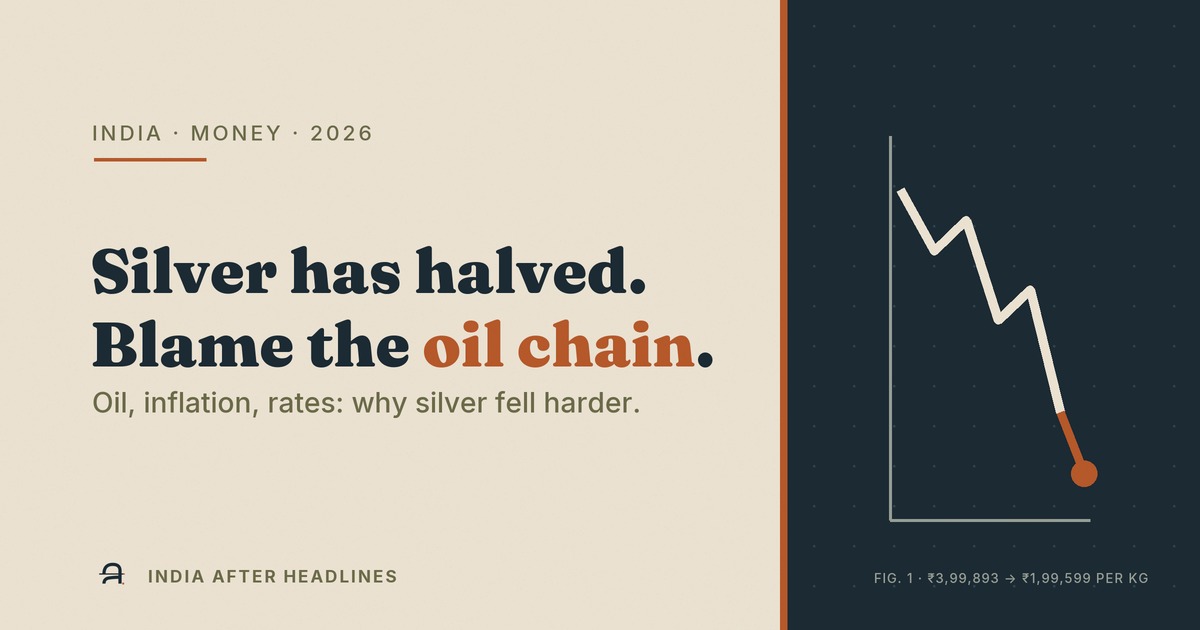
Why Has Silver Halved in 2026? From ₹4 Lakh to ₹2 Lakh a Kilo, Explained
Silver closed at half its January record on 22 October. It wasn't a scam or a collapse in demand for jewellery. It was a chain that started with crude oil.
PSU Bank Stake Sale 2026: Central Bank, UCO, IOB, Punjab & Sind — Is Your FD Safe?
After IDBI, the government wants to sell part of four more banks. That part isn't privatisation, and the legal cover on your deposit never depended on who owns the bank.